


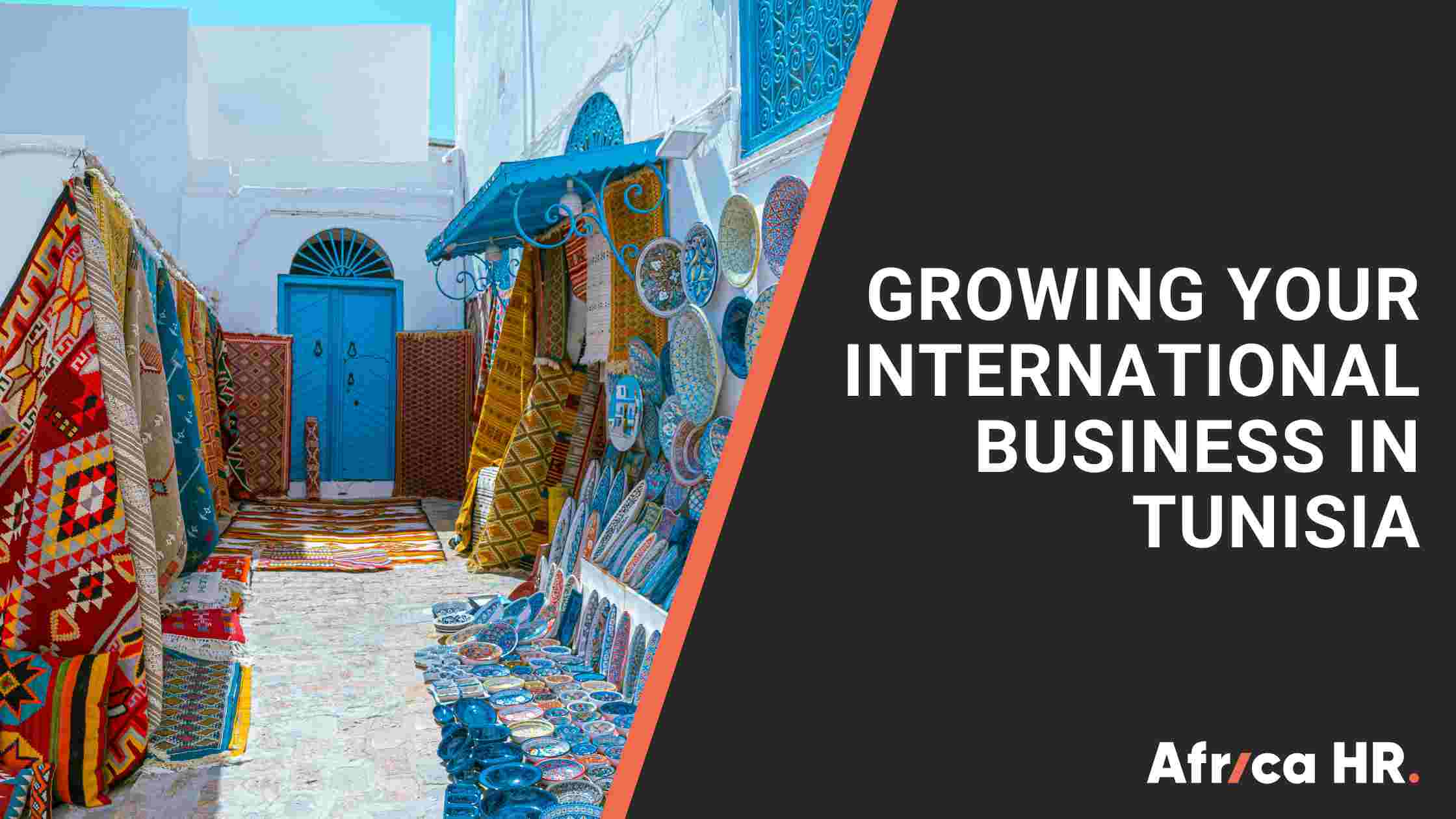
Interested in growing your international business in Tunisia? Here’s everything you should know before you take the big plunge.
Why *not* expand to Tunisia?
A strategic geographical position, natural resources including petroleum, modern infrastructure, preferential trade terms with the EU, skilled labour…
Tunisia offers a wealth of opportunities, and welcomes new businesses well, ranking 5th in Africa for ease of doing business according to the World Bank in 2020.
Here is everything you need to know about Tunisia before considering an expansion there: from the main industries, the current and forecasted economic climate, the business culture there, to the country’s main resources and labour law:
Tunisia Fast Facts*
Population: 12.4 million people
Territory: 163,610 km2. Tunisia is bordered by Algeria to the west and southwest, Libya to the southeast, and the Mediterranean Sea to the north and east. The northernmost point of Tunisia, Cape Angela, is also the northernmost point on the African continent. Tunisia's territory is characterised by a variety of landscapes, including the eastern end of the Atlas Mountains, the northern reaches of the Sahara Desert, and extensive arable land.
Languages spoken: Tunisian Arabic (Official), Modern Standard Arabic, French, Berber
Currency: Algerian Dinar
FX rate with the US dollar: 1 TND = 0.33 USD
Natural resources: Arable land, olives (of which Tunisia is a major global exporter), petroleum, fertiliser
Main industries: Manufacturing, Petroleum, Mining, Tourism, Textiles & Clothing, Car parts, Mechanical, Electrical, Electronic, and Aeronautic Industries
Politics and governance: Tunisia is a democratic republic, with a president serving as head of state, and a prime minister as head of government. Its court system is influenced by French civil law. The country is divided into 24 governorates for administrative purposes.
*Accurate as of 20th of May 2025
Tunisia Strategic Advantages
1. Geographic location
Tunisia enjoys a favourable location at the crossroads of Africa, Europe and the Middle East. The country’s overall proximity to these three regions facilitates trade and investment. This makes Tunisia a dynamic environment for businesses.
Besides, bordering the Mediterranean Sea offers it privileged access to European markets, together with the opportunity to serve as a nearshore destination for European businesses, especially those looking to expand into the African market.
2. EU relationships
Tunisia enjoys a long-standing preferential trade relationship with the European Union (EU), primarily through the EU-Tunisia Association Agreement. This agreement facilitates trade by lowering tariffs and establishing rules of origin for goods traded between the two regions.
3. Arab relationships
Tunisia has signed the Arab League’s Arab Free Trade Area, and is a member of the Arab Maghrib Union, which looks to facilitate economic integration among its member states.
4. Natural resources
Tunisia is rich in arable land, and is particularly known for olives, of which it is a major global producer. Though it has fewer oil reserves than its neighbours like Libya and Algeria, Tunisia’s resources in petroleum still form a non-negligible part of the country’s exports.
5. Connectivity
Tunisia is a modern country, meeting all the connectivity requirements for a smooth-running business environment. For instance, Tunisia boasts a high mobile phone subscriber rate, with penetration rates reaching 149.7% in 2022. Additionally, 4G network coverage is estimated to be 100% in 2025.
6. Developed infrastructure
Tunisia boasts a well-developed road network, well-maintained ports, and overall high access to essential services like water and electricity. This makes logistics easier for businesses in every industry, and particularly those in trade and manufacturing that rely heavily on the safe transportation of goods.
7. Manufacturing
The manufacturing sector in Tunisia is significant, to say the least. Currently, it constitutes one sixth of the country's’ GDP and employs up to one sixth of the country's population. The textile sector, mechanical and electronic manufacturing, together with the production of car parts, make up a bulk of Tunisia’s manufactured products. Since Tunisia already has so much of the infrastructure in place, expanding there is made much easier for businesses operating in this industry.
Tunisia main industries
1. Manufacturing
Tunisia is a major manufacturer of electronics, car parts, and textiles, among other products.
2. Petroleum
Tunisia produces and exports oil products.
3. Mining
Aside from petroleum reserves, Tunisia also has iron ores, lead, zinc, and salt which are mined, sold on the local market (especially in the electronical manufacturing industry) and exported.
4. Tourism
Tourism is growing in Tunisia, becoming one of the country's main sources of foreign currency.
5. Textiles & Clothing
Tunisia is known for its textile sector, supplying the European Union.
6. Car parts
There are more than 260 car part companies operating across Tunisia, with 65% of them being singularly focused on exports. These companies operate across the full automotive value chain. These include spare parts, electrical cables and wiring, electronics, engine components, design, plastics and rubber, as well as textiles and leather.
7. Mechanical, Electrical, Electronic, and Aeronautic Industries
Tunisia labour law – a quick guide*
Public holidays: 13 days per year.
Annual leave: 1 day of annual leave per month. After 1 year of service, they will accumulate 12 vacation days.
Sick leave: To qualify for sickness benefits, an employee needs a minimum of 50 days of covered employment in the preceding two quarters or 80 days in the last four quarters prior to the onset of sickness. The eligible employee is entitled to receive 66.7% of their daily average earnings for a duration of 180 days, commencing after a five-day waiting period.
Maternity leave: 30 days of leave. To receive 66.7% of their daily earnings, the employee must have contributed to social insurance for at least 80 days in the four quarters leading up to the birth.
Paternity leave: 1 day.
Overtime rules: All overtime work must be compensated additionally to the base salary. For the full-time work of 48 hours per week: 75%; For full-time work of less than 48 hours per week: 25% up to 48 hours, and 50% beyond that. beyond this period; for part-time work: 50%
Probation: 6 months for workers ("agents d'exécution") 9 months for first line supervisors ("agents de maîtrise"), and 1 year for executives.
Working permits: A work permit can be obtained subject to approval by the local immigration authority.
Working hours: A work week is 5 days and should not exceed 48 hours.
Termination: For an employer to end an employee's contract, a substantial and justifiable reason must be provided. Prior to termination, the employee retains the right to appeal their case before a disciplinary council. A written notice period of 1 month is required. Employees are eligible for severance pay unless termination is due to misconduct. The calculation for payment involves 1 day's pay for each month of employment, with a maximum severance limit of 3 months' pay.
*Accurate as of 20th of May 2025
Expand to Tunisia worry-free
Through our Tunisia Employer of Record (EOR) offer, Africa HR Solutions takes care of all the administrative hurdles on your path to expansion. We become the legal entity through which you operate in full compliance with Tunisian law. Our team takes over onboardings, payroll, tax remittance, benefits administration, and many other responsibilities so you can focus on growing your business in Tunisia.
To find out more about how we can help you, chat with one of our consultants.
Table of Contents
You may also be interested in: