
Payroll in francophone West Africa: the key patterns employers should know
“Expect differences at all levels: cultural, procedural, logistical, legal...”
This is a statement often made about doing business in Africa. It is true; the continent houses such regulatory diversity and cultural richness that the worst advice one could take would be to have a one-size-fits-all approach to business and payroll across multiple African countries.
That being said, there are similarities and patterns across regions such as francophone West Africa.
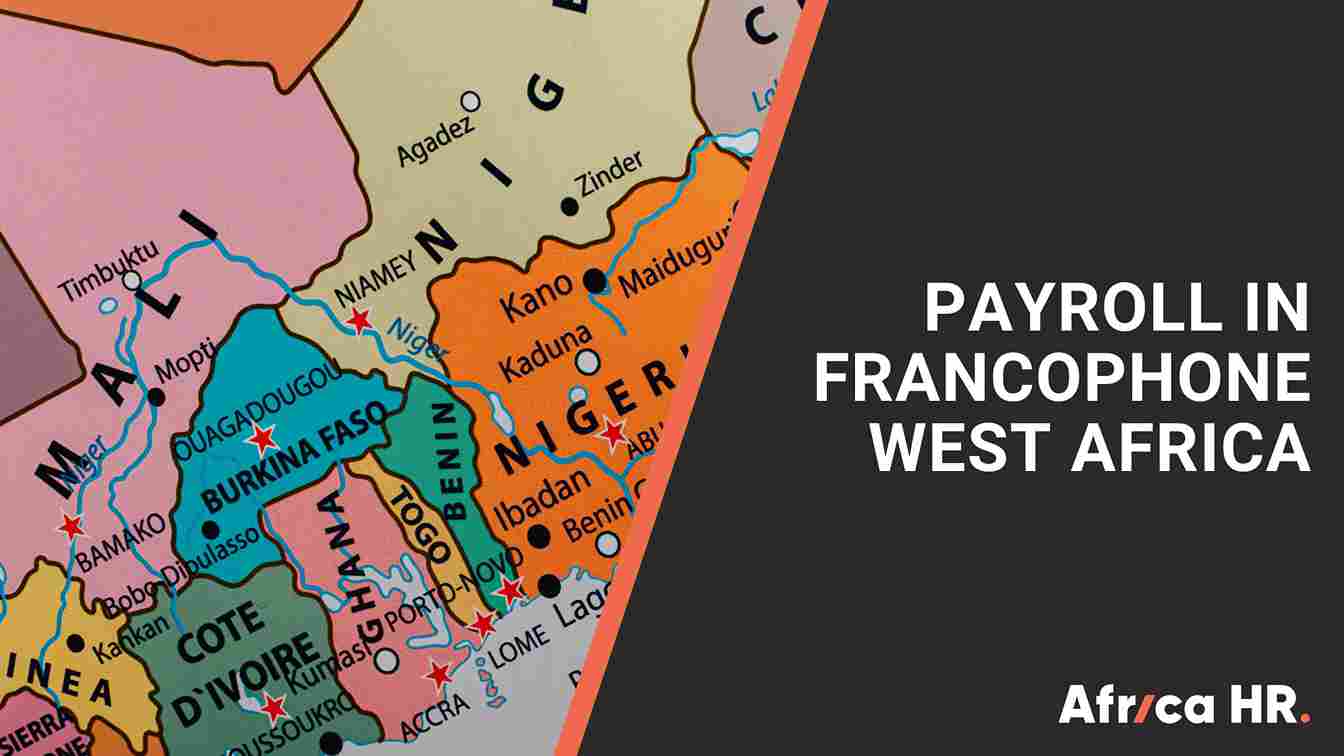
Shaped by similar forces, sharing both history and culture, this particular group of countries (which includes the likes of Côte d'Ivoire, Senegal, Burkina Faso, Mali, Togo, Benin, Niger, and Guinea), has a lot in common, especially where payroll is concerned.
In this article, our in-country experts walk you through the similarities and differences you can anticipate when running payroll in francophone West Africa.
A shared legal and monetary foundation
Most francophone West African countries operate within overlapping legal and economic frameworks. But how can that be if every country has its own legal systems in place? The answer is simple: OHADA (the Organisation for the Harmonisation of Business Law in Africa). It is a system of unified corporate law adopted by 17 West and Central African nations. OHADA operates mainly through a supranational approach where Uniform Acts apply automatically. These supranational laws override domestic laws. This provides a level of legal cohesion that is otherwise difficult to come by across Africa.
One example of an OHADA law would be payroll management. It is governed by the Uniform Act on the Organisation and Harmonisation of Company Accounting Systems (AUDCIF). This provides the framework for recording personnel costs, and national labour codes, which determine salary amounts and deductions.
OHADA does not have a single, unified "Labour Act". However, it does harmonise how employee expenses are recorded in financial statements.
A shared legal monetary foundation
The commonalities don’t stop here. Some francophone West African countries are members of a common monetary union.
The West African Economic and Monetary Union (UEMOA) binds together 8 West African states (Benin, Burkina Faso, Côte d'Ivoire, Guinea-Bissau, Mali, Niger, Senegal, and Togo). They share the West African CFA franc (XOF) as a common currency. The CFA franc is pegged to the Euro at a fixed rate of 655.957. This provides currency stability on top of regulatory uniformity, a combination that is genuinely rare across Africa.
But what does this mean concretely for employers?
Practically speaking, this means lower exchange-rate volatility risks when running payroll in XOF. There would be a greater such risk for other currencies, for example the Nigerian naira or the Ghanaian cedi.
There is an outlier in this picture, however.
Guinea is not a UEMOA member. It uses its own local currency, the Guinean franc, and sits outside the CFA franc zone, adding a layer of complexity for employers operating there.
Labour codes rooted in French legal tradition
Each country in francophone West Africa has its own distinct labour code...but they do share a common ancestor: French labour law.
Côte d'Ivoire's labour market is governed by its Code du Travail of 2015, which is modelled after French labour law, with the Inspection du Travail overseeing enforcement. The same pattern holds true across Senegal, Burkina Faso, Mali, and their neighbours. Employers will find a generally employee-siding labour law (as is typical of French labour laws), as well as familiar concepts across the board:
- Indefinite-term and fixed-term contracts
- Probationary periods
- Mandatory notice
- Sector-specific collective agreements
Where regulations are structured in similar ways, their execution is often different. These laws rarely carry the same exact values when it comes to the amount of a fixed penalty, or the maximum number of months that define a fixed-term contract, for example.
For example, fixed-term contracts are permitted for up to 24 months in Côte d'Ivoire, typically for seasonal work, temporary replacement, or defined projects, and all employees must receive clear documentation outlining duties, compensation, duration, and working conditions.
In Burkina Faso, a single fixed-term contract for local workers can run for no more than two years, while for foreign workers this can extend to three.
Usage of French language
It may seem obvious, but amid Africa’s linguistic and cultural diversity, it is important to point out that across francophone Western Africa, contracts must generally be made in writing in French, the official language, and signed by both parties before execution.
Across the entire region, French is the operative language of employment law. Contracts, payslips, declarations to social security bodies, and submissions to labour bodies must all be in French. For multinational employers that are accustomed to operating in English, this requires a deliberate adjustment.
One way to make this adjustment less rocky is to work with a multilingual payroll partner. Our in-country teams speak the local language in 46+ African countries, including the francophone West Africa region.
To find out how we can best support your payroll needs, get in touch with one of our consultants today.
Social security: country by country, but structurally similar
Every country operates a national social security fund, and registration with this fund is a non-negotiable first step in the payroll process. In Côte d'Ivoire, the relevant body is the Caisse Nationale de Prévoyance Sociale (CNPS). In Senegal, contributions flow to the CNSS (Caisse Nationale de Sécurité Sociale) and IPRES (Institution de Prévoyance Retraite du Sénégal). Burkina Faso has its own CNSS. The names differ, but the structure is familiar: mandatory contributions covering pensions, family benefits, and workplace accident insurance, split between employer and employee.
The employees only pay 6.3% for the CNPS Retirement Fund and the employer pays 7.7% of the taxable salary to the CNPS Retirement Fund (for a total of 14%). The other contributions are paid by the employer. The monthly ceiling for the CNPS Retirement Fund is XOF 3,375,000, and the monthly ceiling for the other contributions is XOF 70,000.
In Senegal, employers contribute to pensions (8.4%), family benefits (around 7%), and medical coverage among other things. The monthly rate is 6% to be levied on a contribution rate between XOF 60,000 and XOF 250,000, for both the employee and the employer.
The deadlines are tight and the penalties for late or inaccurate filing are real. Errors in contribution rates or payment delays can trigger fines or interest charges. The same principle applies region-wide: social security compliance is not an area where approximation is tolerated.
Income tax withholding
Personal income tax in francophone West Africa is progressive and administered by the employer. They are responsible for calculating, withholding, and remitting employee income tax each month. The applicable rates and brackets vary by country, but the structure (taxable gross salary less allowable deductions, taxed on a progressive scale) is consistent across the region.
In Senegal, the personal income tax (known as IRPP) uses a progressive scale ranging from 0% to 43%, and even lower-income workers pay a Minimum Personal Income Tax.
Employers are liable if they fail to deduct or remit IRPP properly, with penalties and interest applying for errors or late payments.
Minimum wages and the SMIG
Each country sets its own minimum wage, known as the Salaire Minimum Interprofessionnel Garanti (SMIG). These are periodically revised and are legally binding floors across all formal employment.
What makes payroll genuinely complex here
Although these structural similarities make payroll seem easier across the region, it doesn’t necessarily mean that these skills are transferable.
An employer who is managing payroll in Senegal cannot simply replicate this success in Côte d'Ivoire without adjustment. Contribution rates differ, tax brackets differ, the relevant social security bodies have different registration procedures and portals, and collective agreements are country-specific and sector-specific.
Partnering with a specialised payroll provider remains one of the best choices for companies looking to operate across a number of francophone West African countries.
Frequently Asked Questions
Do francophone West African countries share similar payroll rules?
Yes, there are important similarities. Most countries in the region are part of OHADA, which provides unified business law, and many belong to the UEMOA monetary union that uses the shared West African CFA franc (XOF). Labour codes are all rooted in French legal tradition, creating common concepts such as contract types, probation periods, and social security structures.
Which countries use the CFA franc, and why does it matter for payroll?
Eight countries (Benin, Burkina Faso, Côte d'Ivoire, Guinea-Bissau, Mali, Niger, Senegal, and Togo) are part of the UEMOA and use the West African CFA franc (XOF), which is pegged to the Euro. This brings currency stability and reduces exchange-rate volatility for payroll. Guinea is the main exception, as it uses its own Guinean franc and sits outside the CFA zone.
What language requirements apply to employment contracts and payroll documents?
All contracts, payslips, social security declarations, and official submissions must be in French, the official language across francophone West Africa. Documents must be written in French and signed by both parties. Multinational employers accustomed to English operations need to adjust to this requirement.
How does social security work in francophone West Africa?
Every country has its own national social security fund (such as CNPS in Côte d'Ivoire or CNSS in Senegal and Burkina Faso), but the overall structure is similar. Employers and employees make mandatory contributions covering pensions, family benefits, and work accident insurance. Contribution rates and ceilings vary by country, and timely, accurate filing is strictly required.
Why is payroll still complex across francophone West Africa despite the similarities?
While the legal foundations and structures are comparable, the details differ significantly between countries. Contribution rates, tax brackets, social security bodies, registration procedures, minimum wages (SMIG), and sector-specific collective agreements all vary. Success in one country does not automatically transfer to another without local adjustments.